Stand-In Cities: How UK Film Offices Sell Towns as Somewhere Else
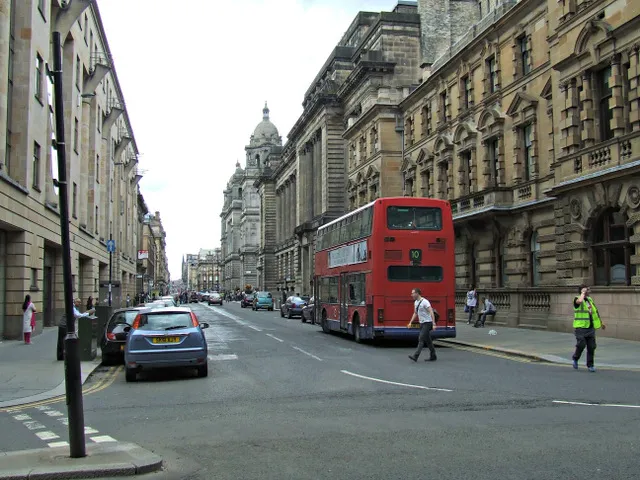
Photo: Thomas Nugent , CC BY-SA 2.0, via Wikimedia Commons
On a wet Tuesday in a town square somewhere between Leeds and the coast, a location scout is trying to see 1920s New York. The stone is wrong, the bins are wrong, and a bus shelter is doing its best to ruin the illusion. Then the film officer points out the light, the width of the pavement, the fact that the council can close the road for two nights, and the scout starts to nod. This is how a town becomes somewhere else.
Regional film offices are the matchmakers of UK production. They are part economic development agency, part fixer, part location library, part diplomatic service. Their job is to sell a place to producers — not as itself, but as a stand-in for Paris, New York, Berlin, Moscow or a fictional city that exists only in a script. In 2026, with streamers and broadcasters chasing value and the UK’s nations and regions fighting for every shoot, that pitch has become more sophisticated.
The pitch is a package
A film officer does not just send a photo of a pretty street. They send a package: location options, unit base possibilities, parking, crew numbers, local facilities, distance to London, and a council that will answer the phone. They know which high street can take a crane, which park can hold a base camp, and which listed building will say yes if the rig is small enough. They also know the value of a good recce. A producer with three days in the UK does not want to discover the perfect square on Google Earth and then find out it is pedestrianised, heritage-listed and next to a school.
The sell is not architecture alone. It is permission. A town that can close a road, manage residents’ letters, provide traffic management and keep the local paper onside is worth more than a prettier town that cannot. Film offices talk about ‘film-friendly’ the way other people talk about good schools: it is a reputation built one shoot at a time.
The paperwork is the pitch
Hosting a shoot is a logistical relay. There are road closures, parking suspensions, noise restrictions, night shoots, police liaison, fire safety, highways, environmental health and, often, a listed building consent. The film office is the translator between a production’s schedule and a council’s risk register. It is also the number a resident can ring when a base camp generator starts humming at 6am.
The best offices have a crew database, a locations library and a relationship with local hotels, caterers and plant hire firms. They know that a production spending three weeks in town will not just pay location fees. It will book beds, buy breakfast, hire vans, rent car parks and leave a trail of receipts. That is the economic ripple effect — less glamorous than a red carpet, but more reliable.
The ripple effect
A major shoot can be a short, intense economic event. Crew spend, accommodation, catering, security, cleaning and local suppliers all benefit. There is also the longer tail: screen tourism, skills development and the sense that a place is on the map. A town that has hosted a big production can pitch itself again with proof. ‘We can do this’ is a powerful sentence in a council meeting.
But the ripple is not automatic. A production that brings everything with it leaves less behind. The film offices that do well are the ones that build local capacity — training schemes, crew placements, supplier lists — so that the next shoot needs fewer outside hires. That is slower work than landing a Netflix title, but it is the difference between a one-off and a production base.
The unsung doubles
Some UK locations have become reliable stand-ins. Liverpool’s waterfront has been dressed as 1920s New York; Glasgow has played Philadelphia; London streets have doubled for Paris and Berlin. But the unsung heroes are the towns that do not have a postcard identity. Hull, Wakefield, Halifax, Blackburn, Middlesbrough, Scarborough, Margate, Dover, Swansea, Derry/Londonderry: these are places with texture, scale and councils that have learned how to say yes.
A film officer in one of these towns will tell you that the job is partly about managing expectation. Not every shoot is a blockbuster. A three-day commercial can still pay for a new crew member’s rent. A returning drama can build a relationship that lasts a decade. The pitch is not ‘we are Paris’. The pitch is ‘we can be Paris for a week, and we will make it easy’.
The 2026 squeeze
This year, the pressure is on. UK production is busy but budgets are cautious, and producers are looking for value outside the M25. Regional film offices are competing with each other, with Scotland, Wales and Northern Ireland, and with international incentives. The ones that win are not always the ones with the biggest tax credit or the most famous cathedral. They are the ones that answer emails, solve problems and make a producer feel like a guest rather than an imposition.
That is the quiet art of the location double. A town does not need to look like Paris. It needs to look like a place where Paris can happen. The film officer’s job is to make that believable — and then to make the paperwork disappear. When it works, nobody notices the town at all. They just notice the story.