The Long Memory of a Shoot: How UK Script Supervisors Keep the Story Straight

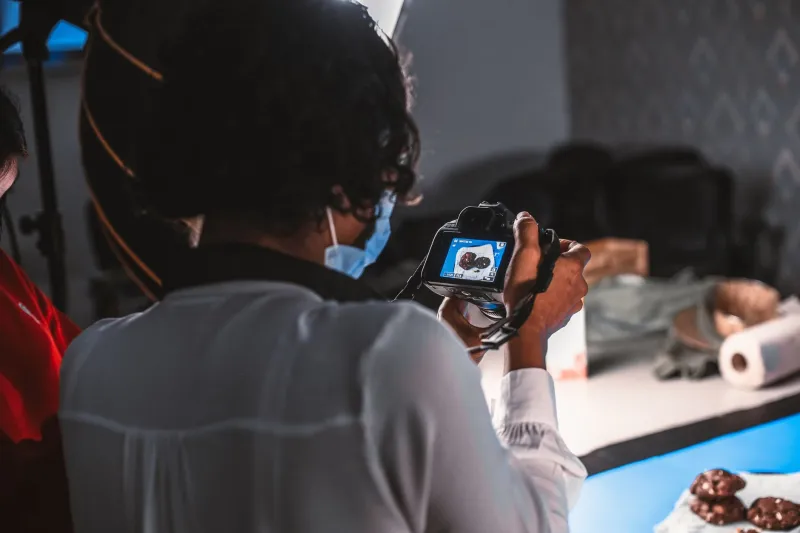
Photo: Senia Novak, CC BY-SA 4.0, via Wikimedia Commons
There's a moment on almost every UK shoot where something slips and barely anyone clocks it. A watch has jumped to the wrong wrist. A bruise has migrated north overnight. A character who was mid-bacon-roll in the wide is suddenly empty-handed in the close-up. The camera department is happy, the gaffer is happy, the director is happy. And then a quiet voice by the monitor says: "He had the envelope."
That voice belongs to the script supervisor. And if you've never noticed them, that's largely the point.
The Book Has a Battery Now
For decades, continuity lived in a hardbacked notebook: lined pages, columns, arrows, a pencil that never stopped moving. Plenty of supervisors still keep a paper version, partly because it's faster in the rain and partly because a screen between you and the floor is a screen between you and the floor.
But the working day now runs through software. ScriptE and Movie Magic are common, tablets are everywhere, and annotated scripts get shared round the block at the end of the night rather than photocopied in the production office. The result is more evidence than a supervisor has ever had — and more noise. A film mag gave you a roll number and a hard boundary. A digital card gives you forty takes called something like A023C014, three of which are rehearsals, two of which are pick-ups for sound, and one of which was a warm-up the director will later insist was the best thing anyone has ever done.
So the job has shifted from recording to curating. Which take had the good bit. Which one was technically fine but emotionally flat. Which line was improvised, needs clearing with the writer, and will absolutely come back to bite everyone at the edit.
More Than Props
Ask anyone outside the industry what a script supervisor does and you'll get "checks the cups don't move". Fair, as far as it goes. In practice they are tracking eyelines, screen direction, the 180-degree line, whether an actor's hand was flat or curled on the doorframe, how much of a cigarette was left, which side of the car the wound was on, and how many seconds of a phone call have elapsed across three separate shooting days.
They're also the informal archive of performance. "In take four she paused before the name," is the kind of note that saves a scene in the edit suite six months later. Directors lean on that memory far more than they admit in interviews, and editors have been known to phone a supervisor long after wrap to ask a question only they can answer.
Then there's the scripting side — changes made on the floor, lines cut for time, new jokes tried at 4pm on a Friday. Somebody has to write it down in a form the writer, script editor and post team can actually use. That somebody is usually sitting nearest the monitor with the least glamorous job title on the call sheet.
The Volume Changes the Question
The rise of LED stages and in-camera visual effects has quietly rewritten part of the role. On a traditional set, if an actor shifts half a metre, the background still works. Inside a volume, with a pre-rendered environment playing across the wall, that same shift can break a parallax relationship somebody spent three weeks perfecting in previs.
So continuity now includes the frame's furniture: where the actor stood relative to the tracking markers, how the camera moved, which version of the environment plate was live. Supervisors on virtual production work increasingly sit alongside the previs and asset teams, comparing what was planned with what was shot, and flagging the small discrepancies that would otherwise become expensive fixes downstream.
It's meticulous, unglamorous and absolutely central. As one supervisor with a decade of high-end TV behind her put it, half the job is now describing a shot well enough that someone in another building can rebuild it.
Six Episodes, Four Directors, One Brain
Block shooting on returning drama has made continuity a relay sport. A six-part series might be split across two or three directors and two DOPs, shooting out of order across months, with locations revisited after a six-week gap. The supervisor becomes the through-line — the person who knows that the kitchen was repainted for episode four, that the dog was supposed to be limping by episode five, and that a particular jumper has to survive into the finale because a writer has plans for it.
Turnaround pressure hasn't helped. Shorter schedules mean fewer rehearsals, more cameras and less time for the small conversation at the monitor where problems used to get caught. Good supervisors compensate by being early: reading the next two episodes, checking with the costume and props teams before the day, and knowing which details matter to the story and which are just detail.
Catching Out Is Not the Job
The best in the business are cautious about the gotcha reputation. Continuity, done badly, becomes policing — and policing makes actors nervous and crews defensive. Done well, it's a form of protection: the show's internal rules stay consistent, so the audience never has to spend a scene working out whether they've missed something.
Which sometimes means letting a mistake stand. A scarf that moves between takes is nothing if the performance is extraordinary. A character who contradicts a line of dialogue from three episodes back is a problem. Knowing the difference is the craft, and it's why experienced supervisors get booked years ahead by producers who've been saved by them before.
How You Actually Learn It
There's no tidy degree route. Most supervisors come up through the production office, the floor, or years as a runner and then a second AD, then shadow someone good for a few shows. ScreenSkills and the various training bodies run short courses, and BECTU rates give a sense of where the role sits in the hierarchy, but the real education is repetition: watching a scene break and learning to spot, in real time, which of the twelve things that changed is the one that matters.
The role is also, quietly, one of the industry's more dependable freelance careers — in demand across high-end TV, indie film and the growing regional studio circuit from Cardiff to Leeds to the Bottle Yard in Bristol.
So next time you're watching a British drama and nothing at all feels wrong — the teacups, the weather, the scar, the accent, the exact number of steps from the door to the sofa — spare a thought for the person at the monitor with the laptop, the pencil and the long memory. They've been holding the thread the whole time.