The Second Life of the Flats: Inside Britain's Set Salvage Circuit
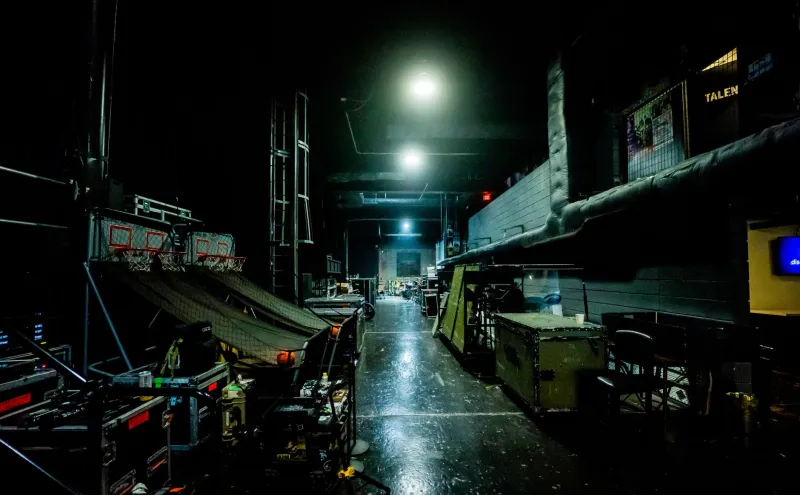
At ten past six on a Friday, the last shot is in the can and the director has said the words. By Monday morning the skip is on the street. A living room that took three weeks to dress — the right shade of paint, the secondhand paperbacks chosen by someone with firm opinions about the character's reading habits — is reduced to painted flats and a pile of splintered MDF before the thank-you emails have been answered.
That gap between the final clapperboard and the empty stage is where a quiet corner of the British industry now does its most interesting work. Call it the afterlife of the set: the depots, prop libraries and salvage yards that decide whether a build becomes landfill, becomes storage, or becomes somebody else's third-act kitchen.
The bill that turns up after the wrap
For decades the logic was simple. Build fast, strike faster, move on. Storage was rent you paid for nothing; a finished production had no reason to keep its walls. What has changed is that the cost of throwing things away has become legible. Skips are not free. Neither is the labour to fill them, the permits to park them, or the scrutiny that now arrives with every sustainability report attached to a public funding application.
Sustainability coordinators — a role that barely existed on British sets a decade ago — have pushed the conversation upstream. The useful question is no longer 'how do we recycle the skip?' but 'why is there a skip?' That shift has dragged construction managers, set decorators and scenic artists into arguments about glue, screws, paint systems and whether a wall needs to be a wall at all.
The prop house as a lending library
Walk into any established prop house in London, Bristol or Glasgow and you are walking through a savings account. Set decorators do not, on the whole, buy things; they hire them. A mid-century sideboard goes out on Monday for a period drama in Cardiff, comes back on Friday, and goes out again the following week for a commercial. The hire model is the oldest circular economy in the business, and it quietly underwrites the visual density British television is known for.
The friction comes with the items that fall outside the library. A bespoke build, a hand-painted sign, a chair reupholstered to match a character's arc — these are bought outright, and after the wrap they sit in a container in Park Royal or a lock-up outside Leeds, costing money, until someone remembers them or someone writes them off.
Designing for the second take
'You can't retrofit a skip,' one Bristol-based set decorator tells me, with the tone of someone who has tried. The practical answer is design for disassembly: flats that bolt rather than glue, finishes that can be repainted rather than replaced, modular pieces that survive a change of period with a change of handle.
For scenic artists this is a genuine craft question, not an administrative one. A faux-marble finish built up over four layers is a beautiful thing and a nightmare to strip. The artists now thinking hardest about reuse are the ones treating a paint job as a stage in a longer life — choosing a base that can be overpainted, sealing rather than bonding, signing and dating the back of a flat so the next production knows what it is inheriting.
The regional circuit is where it gets interesting
The reuse story is not a London story. Regional studios and the depots around them have made short journeys normal, and short journeys are what make salvage viable. A set struck at The Bottle Yard in Bristol has a reasonable chance of being stored within a few miles and rehired by the next production through the same gate. The same is true around Space Studios in Manchester, First Stage in Scotland and the cluster of stages in and around Cardiff.
Local film offices have started to act as matchmakers, circulating strike lists to neighbouring productions the way they once circulated location lists. It is unglamorous, spreadsheet-heavy work, and it is probably the most effective sustainability measure in the country.
The arithmetic of keeping things
None of this is free. Storage costs money, cataloguing costs time, transport costs diesel, and a production accountant will always be able to show you a cheaper line for 'disposal'. The counter-argument is that the true cost of a build is spread across the whole life of the material, not just the shoot — and that a production which reuses is also a production that buys less in the first place.
There is a cultural point underneath the spreadsheet. Sets are arguments about permanence. We spend months making something look as though it has always been there, then a weekend proving it hasn't. The salvage circuit is a small, practical correction to that — a way of letting the work have a second life, in a second story, for a second audience.
The skip will still turn up on Monday. But increasingly, it turns up half empty.